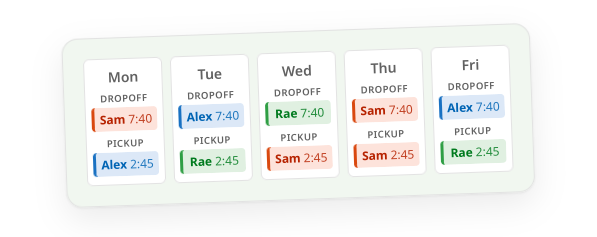
This year my wife and I faced a new chore - dropping off and picking up our teenager at school every day. We started by just keeping track manually, but it was time consuming constantly creating calendar invites, swapping days, etc.
What I really wanted was a single place where I could see all the dropoff and pickup slots on a monthly calendar and have it seamlessly update my calendar or my wife’s calendar as we decided who would do what. And nowadays with AI tools, if you need something, you build it!
So I created DrivingDuty, which lets you plan a month of dropoffs and pickups easily. It syncs automatically with your calendar and allows you to assign or reassign slots with a single click.
You may be asking if this is totally vibe coded, and the answer is No. I’ve vibe coded other apps recently, and while I was able to create apps much faster than I could have pre-AI, I found the whole experience deeply unfulfilling and not at all fun. I use these side projects as a hobby, and why would I want to delegate the fun parts of my hobby to an AI?
So I decided I would take the steering wheel and use AI as a copilot. Initially, I started by iterating with Claude on a design. Claude was determined to store dropoff and pickup slot assignments in a database as well as writing them to the calendar. At first this seemed reasonable, but it introduced a never ending set of potential race conditions and reconciliation work. Claude kept suggesting adding more and more layers of checks and controls to prevent race conditions.
This is when I realized that AI may be great at coding but can still sometimes fail at design. Once I stepped back and thought about it myself without Claude’s naggy voice in my ear, I realized the solution was simple: cut out the database. The answer to the race conditions was not to introduce race conditions in the first place. DrivingDuty now uses the calendars as the source of truth for who is assigned which slot, and this works great.
After this experience, I created a skill called /guide-me which allows me more control of what and how we build. It is written such that Claude explains, reviews, and hints, but does not write the implementation. I tell Claude to guide me in building a certain feature, and it helps me get started and gives me guidance and pointers as I go. I used this approach for tricky aspects of the app, such as building the Google and Zoho Calendar integrations. In other areas, I wrote the code myself to start and relied heavily on Claude as a code-reviewer. And yes, in some tedious areas as integration and e2e tests, I did have Claude fully write some the code and I reviewed it.
Overall, I’m very happy with how DrivingDuty turned out and more importantly I’m glad to have found a way of working with Claude that helps me go quickly but doesn’t take all the fun out of building!